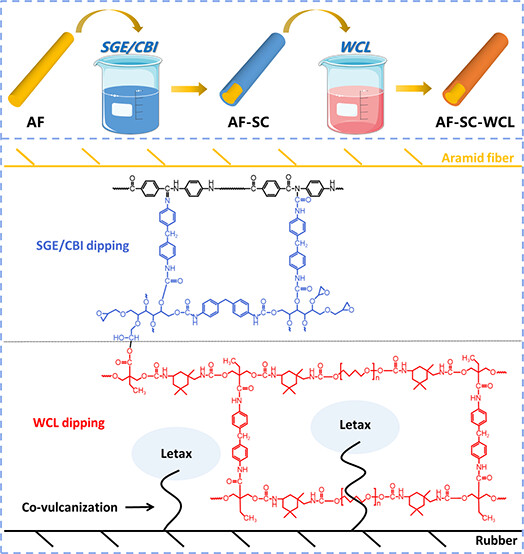
Interfacial bonding between aramid fiber (AF) and rubber is crucial to the performance of composites. However, the widely used resorcinol-formaldehyde-latex (RFL) dipping system is not environmentally friendly due to the significant use of formaldehyde. In this study, a new environmentally friendly dipping system was designed and prepared. In this system, the synthesized anionic waterborne polyurethane reacts with capped isocyanates to form a resin network structure, which is then mixed with rubber latex to prepare the environmentally friendly WPU-capped isocyanate-latex (WCL) system. Waterborne polyurethane (WPU) uses water as a dispersion medium and has low volatile organic compounds, offering significant environmental advantages. AF was activated by dehydrated sorbitol glycidyl ether and closed diisocyanate and then dipped with the WCL. The results of XPS and FTIR-ATR showed that the surface chemical activity of the treated AF fibers was improved. The H pull-out force between the dipped fiber and the rubber reached 160 N, matching the performance level of the RFL system (152 N). The WCL dipping solution demonstrated excellent storage stability. The dipped fiber strength loss was less than 5%, which does not affect the normal use of the fiber. This method represents a mature technological path with high efficiency and can be directly applied to industrial production. Furthermore, the interfacial adhesion mechanism between AF and rubber has been elucidated. This study offers new insights into the interfacial design of AF-reinforced rubber composites and the development of environmentally friendly dipping systems.
https://pubs.acs.org/doi/10.1021/acs.iecr.4c04920