Recently, Academician Liqun Zhang, Professor Jun Liu and Associate Professor Weifeng Zhang from Beijing University of Chemical Technology, together with Academician Zhonglin Wang from the Beijing Institute of Nanoenergy and Nanosystems, has published a research paper entitled “All-Solid Biomass Dual Network Ionic Conducting Elastomer with Multi-Ion Synergy for Low-Temperature Resistant Sensor and Triboelectric Nanogenerator” in the internationally renowned journal Advanced Materials. The work reports significant progress in developing an all solid state, low temperature tolerant, and high performance ionic conducting elastomer through biomimetic design and a multi ion synergy strategy.
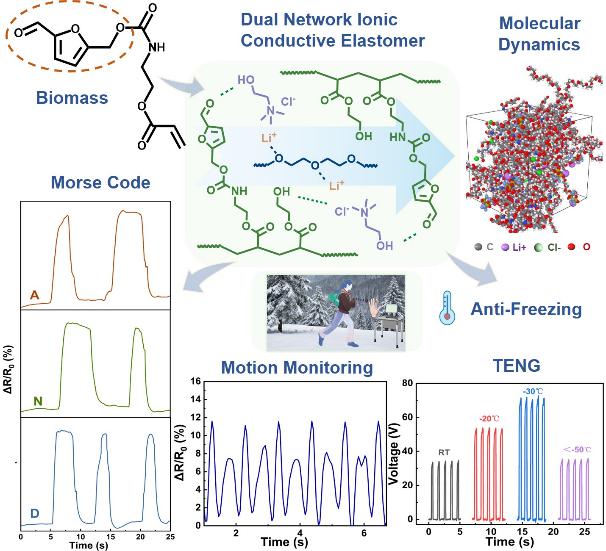
Figure 1. Design and applications of bio-based double-network ionic conducting elastomer
With the rapid advancement of flexible electronics, there is an increasing demand for materials that combine high mechanical strength with excellent ionic conductivity. However, traditional conductive materials such as hydrogels suffer from issues like dehydration, leakage, and performance degradation at low temperatures, severely limiting their reliable application in extreme environments. To address these challenges, the research team developed an all-solid-state biomass-based dual-network ionic conducting elastomer. Through a sophisticated synergy of lithium-ion coordination and hydrogen bonding, the material achieves a remarkable balance between mechanical strength (0.877 MPa, 587% elongation) and ionic conductivity (3.74 × 10⁻³ S m⁻¹). A strain sensor fabricated from this elastomer can operate stably at –20 °C and has been successfully applied in Morse code-based encrypted communication. Moreover, when used as a stretchable triboelectric nanogenerator, it delivers a power density at –30 °C under a 1 MΩ load that reaches 290% of its room-temperature performance, demonstrating great potential to replace conventional low-temperature batteries.
The first authors of the paper are Master’s student Qiying Zhang from Beijing University of Chemical Technology and Ph.D. candidate Siyao Qin from the Beijing Institute of Nanoenergy and Nanosystems. The corresponding authors are Professor Jun Liu, Academician Zhonglin Wang, and Associate Professor Weifeng Zhang. This research was supported by grants from the National Natural Science Foundation of China and other funding agencies.
Link to the paper:
https://advanced.onlinelibrary.wiley.com/doi/10.1002/adma.202523516